

- About Us
- Business Law
- Civil & Commercial
- Antitrust Litigation
- Appellate Litigation
- Banking Litigation
- Breach of Contract
- Breach of Fiduciary Duty
- Business Partnership and Shareholder Disputes
- Commercial Arbitration
- Commercial Fraud
- Construction Litigation
- Employment Litigation
- Insurance Coverage Dispute
- Oil & Gas Litigation
- Pre-Litigation & Dispute Resolution
- Real Estate/Property Dispute
- Trade Secrets & Unfair Competition Litigation
- Family Law
- Resources
- Contact
Our Blog Post
How Debt Is Split During Divorce

Who Pays Marital Debt After a Texas Divorce
Credit card balances, car loans, and a mortgage can feel as tangled as the marriage itself once it ends. In Texas, how debt is split during divorce depends on a “just and right” standard: the judge divides marital debt in the way the court finds fair, which does not have to mean a 50/50 split. What the decree orders your spouse to pay and what a lender can still collect from you are separate questions.
The Just and Right Standard a Texas Judge Applies
Rather than splitting each balance down the middle, the judge looks at your debts and assets together as one marital estate. Section 7.001 of the Texas Family Code directs the court to divide that estate with regard for the rights of each spouse and any children, which is why the same standard governs how a Texas court divides marital property.
That can mean one spouse takes on more of the debt in exchange for more of the assets. If one spouse keeps the home and buys out the other, for example, the mortgage balance is counted against the rest of the division.
Which Debts Are Community Debts?
A debt is usually community debt when a spouse took it on during the marriage. Texas presumes that property either spouse holds during or at the end of the marriage is community property, meaning it belongs to the marital estate, and overcoming that presumption takes clear and convincing evidence.
Separate property is the narrow exception. It covers what a spouse owned before the marriage, property received by gift, will, or inheritance, and personal injury recoveries other than the part for lost earning capacity during the marriage. Which side of that line your balances fall on depends on the facts, such as when each account was opened and what the money paid for.
Are You Liable for Debt in Your Spouse’s Name Alone?
Being married to someone does not automatically make you responsible for every card or loan in their name. Under Section 3.201 of the Texas Family Code, you are personally liable for a debt your spouse took on alone in only two situations.
The first is agency, where your spouse acted on your behalf and with your authority; marriage alone does not create that authority. The second is necessaries: each spouse owes the other a duty of support, and a spouse who fails that duty can owe whoever supplied the other spouse with necessities such as food, housing, or medical care.
Which Property Can a Creditor Actually Reach?
If a creditor comes after a debt, the practical question is whether it can reach your paycheck or your savings. The answer depends on which pool of marital property is involved, who took on the debt, and what kind of debt it is. Each spouse solely manages the community property that spouse would have owned if single, such as personal earnings. Under Section 3.202 of the Texas Family Code, the pools line up this way:
| Property | What It Can Be Used to Pay |
|---|---|
| One spouse’s separate property | Not the other spouse’s debts, unless both spouses are liable under other law |
| Community property one spouse solely manages | Not the other spouse’s premarital debts, or debts from the marriage that involve no wrongful act, unless both spouses are personally liable |
| Community property a spouse solely or jointly manages | That spouse’s own debts, from before or during the marriage |
| All community property | Either spouse’s liability for a wrongful act during the marriage, such as causing a car crash |
When both spouses’ paychecks go into a joint account, those funds generally become jointly managed, which can widen what a creditor reaches. If a judgment could be paid from more than one pool, the judge can decide which property is used first, based on the facts behind the debt.
Does Your Decree Stop a Creditor From Billing You?
No. A divorce decree tells your former spouse what to pay. It does not cancel what you owe a lender under the loan agreement you signed or the liability rules that apply to married couples.
If a former spouse ignores a debt the decree assigned to them, Texas law lets you file suit to enforce divorce orders in the court that granted the divorce. That court can clarify or carry out the original division, but it cannot rewrite it.
Talk With Our Team About How Debt Is Split During Divorce
Sorting out debt can be one of the most stressful parts of ending a marriage, especially when accounts carry both names. Pulling the statements for every account either spouse holds, and noting the name on each, is a useful place to start.
Our Houston family law team at Murrah & Killough, PLLC can review which balances may follow you after the decree. For guidance on how debt is split during divorce in your situation, call 281-501-1601 or contact us.
Contact Murrah & Killough, PLLC for skilled divorce law litigation.
Contact the experienced lawyers at Murrah & Killough, PLLC today & schedule your free consultation. We proudly serve Houston, & all throughout Texas. Visit our law offices at:
Our Houston Office
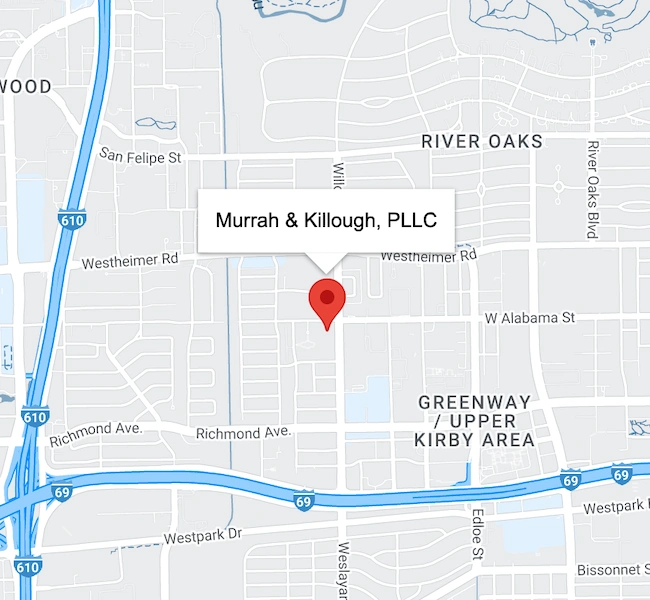
3000 Weslayan St. Suite 305
Houston, Texas 77027
Phone: (281) 501-1601
Contact Our Team Today!
Fields Marked With An “*” Are Required
"*" indicates required fields

Houston Office
3000 Weslayan St.
Suite 305
Houston, Texas 77027
Phone
281-501-1601
Copyright © 2026 Murrah & Killough, PLLC. All rights reserved.
