

- About Us
- Business Law
- Civil & Commercial
- Antitrust Litigation
- Appellate Litigation
- Banking Litigation
- Breach of Contract
- Breach of Fiduciary Duty
- Business Partnership and Shareholder Disputes
- Commercial Arbitration
- Commercial Fraud
- Construction Litigation
- Employment Litigation
- Oil & Gas Litigation
- Pre-Litigation & Dispute Resolution
- Real Estate/Property Dispute
- Trade Secrets & Unfair Competition Litigation
- Family Law
- Resources
- Contact
Houston Commercial Fraud Attorney
Protecting Your Business from Commercial Fraud
 Commercial fraud can quickly put a business owner in a difficult spot. You may be dealing with false financial statements, hidden debt, a dishonest partner, a vendor who misrepresented a deal, or a buyer who used false promises to get goods, services, or ownership rights. The problem often feels personal because trust usually came before the loss.
Our Houston commercial fraud attorneys with Murrah & Killough, PLLC can help you sort out what happened, what evidence proves the misconduct, and which legal claim fits the facts. The right early steps can protect records, reduce business disruption, and keep the dispute from growing harder to prove. You can use our online contact form or call (281) 501-1601 for a confidential case review.
What Counts as Commercial Fraud in Texas?
Commercial fraud is not just a broken promise. Texas courts usually look for proof of the following:
- Someone made a false statement about an important fact
- Knew the statement was false or made it recklessly
- Intended for another person or company to rely on that statement
- Financial harm resulted from that reliance
Our commercial fraud lawyers may review emails, contracts, invoices, bank records, payment histories, and many other documents to obtain evidence. The goal is to separate ordinary business disappointment from conduct that supports a fraud claim.
Commercial fraud can appear in many forms:
- False financial statements: A company or individual may hide debt, inflate revenue, or misstate assets before a sale, loan, investment, or merger.
- Partner or shareholder misconduct: A business insider may divert funds, conceal transactions, or misrepresent the company’s value during a buyout or dispute.
- Real estate or stock fraud: Texas law allows claims for certain false representations in real estate and stock transactions under Texas Business and Commerce Code § 27.01.
The Law Looks at Proof, Not Just Suspicion
A fraud claim usually rises or falls on proof. A bad result alone does not prove fraud. The strongest cases often show a pattern, such as changing explanations, missing records, fake numbers, altered documents, or internal messages that conflict with what was said to the injured party.
Your attorney can also evaluate related claims. Fraud may overlap with breach of contract, breach of fiduciary duty, conspiracy, negligent misrepresentation, fraudulent transfer, or violations of the Texas Deceptive Trade Practices Act (DTPA). The DTPA bars false, misleading, or deceptive acts in trade or commerce, though business claims under that law can involve special limits and fact-specific issues.
Timing also matters. Texas uses different deadlines for different claims. For many fraud claims, the deadline is tied to the discovery rule, meaning the clock may depend on when the fraud was discovered or reasonably should have been discovered. Delay can still hurt the case because witnesses move, records disappear, and defendants may move assets.
What Damages May Be Available?
The available recovery depends on the claim, the proof, and the contract terms. Some cases focus on out-of-pocket losses. Others include lost profits, benefit-of-the-bargain damages, fee-shifting, or exemplary damages when the law allows them.
Your Houston commercial fraud lawyer may also look for fraudulent transfers. Under Texas Business and Commerce Code § 24.005, a transfer made with actual intent to hinder, delay, or defraud creditors may be voided by the court. That type of claim can matter when a business owner wins a judgment, but the other side has already tried to empty accounts or shift assets.
Key remedies may include:
- Money damages: The injured business may seek compensation for losses resulting from the false statement or dishonest conduct.
- Injunctions: A court may order a party to stop using stolen information, moving assets, or interfering with business relationships.
- Attorney fees: Some related claims or contracts may allow fee recovery, though fraud alone does not always create that right.
Houston Business Conditions Can Shape a Fraud Case
Houston commercial fraud cases often involve more than one county, bank, business entity, or project site. A dispute may be filed in the civil district court in Harris County, Fort Bend County, Montgomery County, or federal court if the facts support federal jurisdiction. The Bob Casey United States Courthouse in downtown Houston serves the Houston Division of the Southern District of Texas, where business disputes with federal issues or diverse parties may proceed.
Houston’s economy also affects the evidence. Energy, construction, logistics, medical, real estate, and investment disputes often involve layered contracts, subcontractors, lenders, brokers, and out-of-state companies. That business environment makes document control especially important. A commercial fraud case here may require a fast review of payment trails, lien records, project files, corporate books, and communications between several companies before the full picture becomes clear.
Why Work With Murrah & Killough, PLLC?
At Murrah & Killough, PLLC, we handle business disputes with a practical view of what the client needs, not just what can be filed. When we handle a commercial fraud case, we identify the false statement, the person who made it, the records that prove it, the money trail, the damages model, and the strongest points for resolution. Our Houston commercial fraud attorneys can help you decide whether a firm demand, mediation, emergency relief, or full litigation is the best fit for the business goal.
If you believe fraud affected your business, we can review the documents, identify the legal claims, and discuss practical options before the dispute becomes more expensive. Our case evaluation can help you decide whether to demand repayment, seek an injunction, pursue damages, defend against a false accusation, or prepare for litigation.
FAQs for Business Owners About Commercial Fraud
Can You Sue If the Other Side Lied During Contract Talks?
Texas law may allow a fraud claim if a party made a false statement that induced you to enter into a deal. A contract dispute alone is not always fraud, so the evidence must show more than nonperformance.
What If Your Business Partner Hid Money from You?
Hidden money may support claims for fraud, breach of fiduciary duty, conversion, or an accounting. The best first step is to preserve bank records, company books, tax records, and messages before they become harder to obtain.
Can a Fraud Case Settle Before Trial?
Many commercial fraud disputes are resolved through direct negotiation or mediation, especially when the records show a clear money trail. A Houston commercial fraud lawyer can still prepare the case as if a trial may happen, because strong preparation often improves settlement leverage.
Speak With a Murrah & Killough, PLLC, Houston Commercial Fraud Attorney Today
If your company has lost money because of false statements, hidden transactions, or dishonest business conduct, a Murrah & Killough, PLLC legal professional can review your situation and help you decide what to do next.
Please call (281) 501-1601 or use our online form to speak with a skilled Houston commercial fraud lawyer. We can discuss your claim, your defenses, and the steps that you can take to protect your business before the damage spreads. Your conversation will be completely confidential.




Contact Our Team Today!
Fields Marked With An “*” Are Required
"*" indicates required fields

Houston Office
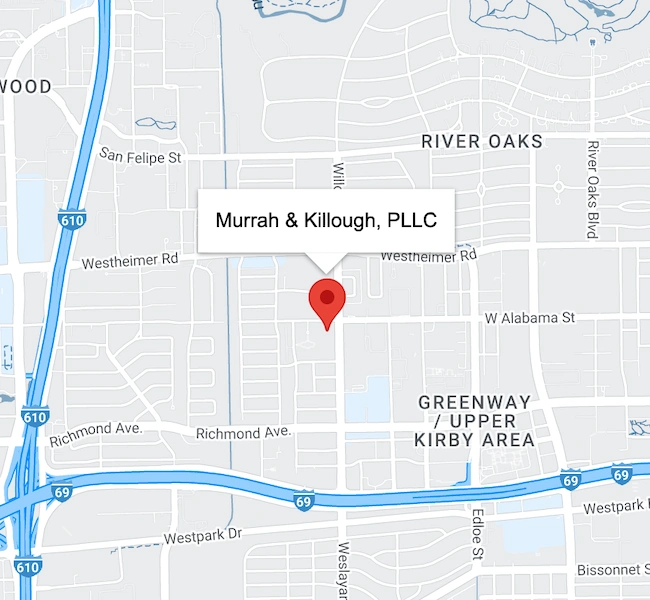
3000 Weslayan St.
Suite 305
Houston, Texas 77027
Phone
281-501-1601
Copyright © 2026 Murrah & Killough, PLLC. All rights reserved.
