

- About Us
- Business Law
- Civil & Commercial
- Antitrust Litigation
- Appellate Litigation
- Banking Litigation
- Breach of Contract
- Breach of Fiduciary Duty
- Business Partnership and Shareholder Disputes
- Commercial Arbitration
- Commercial Fraud
- Construction Litigation
- Employment Litigation
- Oil & Gas Litigation
- Pre-Litigation & Dispute Resolution
- Real Estate/Property Dispute
- Trade Secrets & Unfair Competition Litigation
- Family Law
- Resources
- Contact
Houston Antitrust Litigation Attorney
When Antitrust Law Applies to Your Business Situation
 Business owners often know when competition feels unfair, but antitrust law asks a harder question. Antitrust law is the set of state and federal rules that prevent companies from using unfair tactics, such as colluding with competitors or abusing market power, to control prices or prevent others from competing fairly. Did another company, supplier, buyer, or competitor use unlawful conduct to restrict the market, raise prices, block access, or punish a business for competing? That question can affect a company’s revenue and future.
A Houston antitrust litigation attorney can help sort out whether the problem is hard competition or conduct that may violate state or federal law. If your business is caught in a dispute like this, you do not have to sort it out alone. At Murrah & Killough, PLLC, we review these disputes with care because they often involve contracts, emails, pricing records, and market data. Let us help you protect what you have built. To request a case evaluation, please contact us through our online form or call 281-501-1601 today.
When Business Competition Crosses the Line
Antitrust law steps in when conduct harms competition itself, not just one disappointed competitor. For example, losing a customer to a better offer is not usually an antitrust claim, but a secret agreement between competitors to divide customers or fix prices usually is.
Under the Sherman Antitrust Act (15 U.S.C. §§ 1-7), certain contracts, combinations, conspiracies, monopolization efforts, and restraints of trade are unlawful. Federal law applies when commerce crosses state lines or affects national markets. Our attorneys may need to review both Texas and federal law before deciding where to file a claim.
Common antitrust issues include:
- Price fixing: Competitors agree to set prices, fees, discounts, or bids instead of letting the market decide.
- Market division: Businesses agree to split customers, territories, suppliers, or product lines.
- Group boycotts: Several companies work together to cut off a competitor from suppliers, customers, platforms, or trade groups.
- Monopolization: A company uses market power to block competition through exclusionary conduct instead of offering better products or services.
What Texas Law Adds to an Antitrust Case
 As part of the Texas Free Enterprise and Antitrust Act of 1983, Texas Business & Commerce Code § 15.05 states that every contract, combination, or conspiracy in restraint of trade or commerce is unlawful. The same law also addresses monopolization, attempted monopolization, and conspiracies to monopolize. In a private case, the focus is often on how the conduct affected prices, supply, market access, or the ability of honest competitors to operate.
Not every business dispute belongs in an antitrust claim. If the facts point more clearly to a different kind of claim, that is where the case should be built. A Houston antitrust litigation attorney may also look at related claims, such as breach of contract, fraud, tortious interference, breach of fiduciary duty, trade secret misuse, or unfair competition.
Whichever legal theory applies, strong evidence makes the case. Antitrust claims in particular have strict proof requirements, and evidence often includes:
- Written communications: Emails, texts, meeting notes, bid records, vendor messages, and pricing discussions.
- Market proof: Competitor lists, customer records, product substitutes, geographic reach, and barriers to entry.
- Financial records: Lost sales, changed margins, price changes, and customer loss.
- Contract terms: Distribution agreements, supply contracts, franchise terms, and exclusivity clauses.
Houston Business Disputes Often Need a Local Court Plan
Houston antitrust cases may be filed in state or federal court, depending on the claims, parties, damages, and connection to interstate commerce. The United States District Court for the Southern District of Texas, Houston Division, handles many federal business disputes, and its local rules, electronic filing system, judge procedures, and scheduling orders can shape how quickly a case develops. Harris County civil cases are commonly filed through the Harris County District Clerk, where civil intake, filing fees, and court assignments affect early case steps.
That local setting matters because Houston’s economy spans a spectrum of industries, including healthcare, construction, logistics, and technology. Antitrust disputes here often involve vendor networks, supply relationships, trade groups, and companies that operate across Texas and beyond. At Murrah & Killough, PLLC, we understand that the first filing decision can affect discovery, expert deadlines, injunction requests, and settlement pressure.
How Murrah & Killough, PLLC Approaches Potential Antitrust Disputes
Our business attorneys start by asking practical questions before pursuing a lawsuit. These questions often include:
- What market is affected?
- Who had power in that market?
- Was there an agreement, pattern, or exclusionary act?
- Did the conduct harm competition, or did it only harm one company?
- What damages can be shown with reliable numbers?
Our litigation background matters because antitrust cases can move through several stages before trial. A defendant may file a motion to dismiss, or the parties may fight over confidential business records. Expert witnesses may be needed to explain market definition, pricing, damages, and competitive harm.
Rick Killough, one of our founding partners, has handled civil litigation in federal and state courts, arbitrations, appeals, regulatory matters, and investigations. We use that background to build cases around proof, not noise.
Frequently Asked Questions
What Makes an Antitrust Case Different from a Regular Business Lawsuit?
A regular business lawsuit often focuses on harm to one party, such as unpaid invoices or broken contract terms. An antitrust case focuses on harm to competition in a market, which usually requires more proof about customers, competitors, pricing, and market power.
Can a Small Business Bring an Antitrust Claim in Houston?
Yes, a small business may have a claim if unlawful conduct blocked fair competition and caused measurable harm. Size alone does not decide the case, but the business must be ready to prove the conduct, market effect, and damages.
Should I Save Emails and Pricing Records if I Suspect Antitrust Conduct?
Yes. Emails, pricing records, bid documents, vendor messages, contracts, and customer communications may help show what happened and how it affected the market. Deleting or changing records after a dispute starts can harm a claim or defense, so it is usually safer to preserve all records and let counsel decide what matters.
Talk with Murrah & Killough, PLLC Before the Dispute Controls the Timeline
Antitrust disputes can grow fast because they often involve customers, competitors, pricing data, and business relationships that cannot wait months for attention. A careful legal review can help you decide whether to file suit, defend the company, seek an injunction, negotiate, or use another business solution.
Our Houston antitrust litigation attorneys at Murrah & Killough, PLLC can evaluate the facts, explain the legal path, and help protect your business before the other side sets the pace. Call 281-501-1601 or contact us online today to request a case evaluation.




Contact Our Team Today!
Fields Marked With An “*” Are Required
"*" indicates required fields

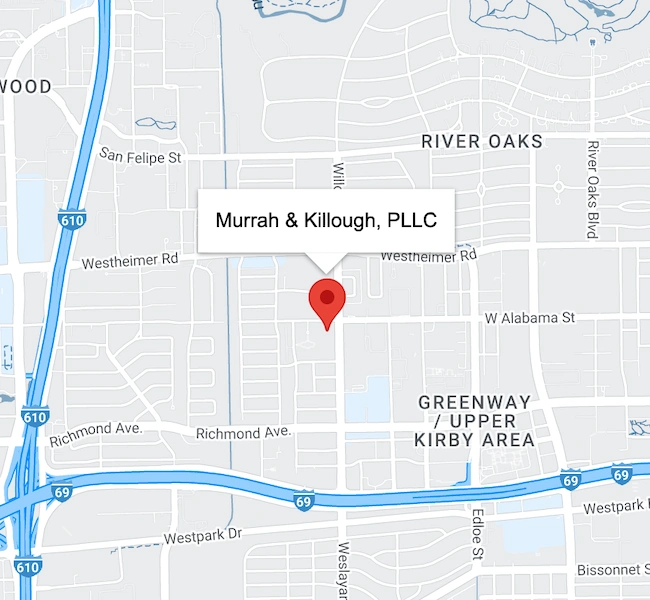
Houston Office
3000 Weslayan St.
Suite 305
Houston, Texas 77027
Phone
281-501-1601
Copyright © 2026 Murrah & Killough, PLLC. All rights reserved.
