

- About Us
- Business Law
- Civil & Commercial
- Antitrust Litigation
- Appellate Litigation
- Banking Litigation
- Breach of Contract
- Breach of Fiduciary Duty
- Business Partnership and Shareholder Disputes
- Commercial Arbitration
- Commercial Fraud
- Construction Litigation
- Employment Litigation
- Insurance Coverage Dispute
- Oil & Gas Litigation
- Pre-Litigation & Dispute Resolution
- Real Estate/Property Dispute
- Trade Secrets & Unfair Competition Litigation
- Family Law
- Resources
- Contact
Frequently Asked Questions About Family Law in Texas
Straight Answers to Common Texas Divorce, Custody, and Support Questions
Family law in Texas covers how a marriage is recognized and ended, how property is divided, and how courts decide custody and child support. Most of these rules come from the Texas Family Code, which sets one standard statewide, though each family’s facts shape the result.
Does Texas Recognize Common-Law Marriage?
Yes. Texas recognizes informal marriage, commonly called common-law marriage. Proving one requires showing the couple agreed to be married, then lived together in Texas as spouses, and represented to others that they were married, as Section 2.401 of the Texas Family Code provides.
If a case to prove the marriage is not started within two years after the couple separated and stopped living together, Texas presumes there was no agreement to marry, though evidence can overcome that presumption. A person under 18 cannot enter an informal marriage.
What Are the Grounds for Divorce in Texas?
Texas allows no-fault divorce. A court may grant a divorce under Section 6.001 of the Texas Family Code when the marriage has become insupportable (legally beyond repair) because conflict has destroyed the legitimate ends of the marriage and there is no reasonable expectation of reconciliation. Texas also keeps fault grounds, such as adultery and cruelty, which require proof of what a spouse did.
What Are the Residency Requirements to File for Divorce in Texas?
At least one spouse must have had Texas as their permanent home for the six months before filing and must have lived in the county where the case is filed for the 90 days before that. Both requirements come from Section 6.301 of the Texas Family Code and are among the basic filing requirements for a Texas divorce.
Is There a Waiting Period Before a Texas Divorce Is Final?
Yes. A Texas court generally cannot grant a divorce before the 60th day after the petition is filed, even when both spouses agree on everything. A court can skip the wait in two family-violence situations under the Family Code’s waiting-period exception.
One is a respondent convicted of, or given deferred adjudication (probation in which the judge postpones a finding of guilt) for, family violence against the petitioner or the petitioner’s household. The other is an active protective order the petitioner holds against the respondent for family violence during the marriage.
How Is Property Divided in a Texas Divorce?
Community property is property either spouse acquired during the marriage, other than separate property. Separate property includes what a spouse owned before the marriage or received by gift or inheritance, and the court does not divide it. The court divides the community estate under Texas’s just and right standard, which is not automatically a 50/50 split.
Because Texas presumes property on hand at divorce is community property, a spouse claiming separate property must prove it by clear and convincing evidence, a key step in property division.
How Does Texas Decide Child Custody (Conservatorship)?
Texas uses the term conservatorship for what most people call child custody. Courts presume it is in the child’s best interest for both parents to be named joint managing conservators under Section 153.131 of the Texas Family Code, meaning they share rights and duties such as decisions about school and medical care. A finding of a history of family violence between the parents removes that presumption. Joint managing conservatorship does not necessarily mean equal time; the schedule for time with the child is set separately.
How Is Child Support Calculated in Texas?
Texas sets guideline child support as a percentage of the paying parent’s monthly net resources, meaning income from nearly all sources minus items such as taxes and the cost of the child’s health insurance. The percentage rises with the number of children under Section 154.125 of the Texas Family Code, and a lower schedule applies when the paying parent’s net resources are under $1,000 a month:
| Number of children | Guideline percentage | Net resources under $1,000 a month |
|---|---|---|
| One | 20% | 15% |
| Two | 25% | 20% |
| Three | 30% | 25% |
| Four | 35% | 30% |
| Five | 40% | 35% |
| Six or more | At least the five-child amount | At least the five-child amount |
The guideline percentages apply to net resources up to a cap the state adjusts every six years for inflation. That cap has been $11,700 a month since September 1, 2025.
Can You Receive Spousal Maintenance (Alimony) in Texas?
Texas allows court-ordered spousal maintenance only in limited situations. The spouse seeking it must lack enough property, including separate property, to meet their minimum reasonable needs after the divorce, and must also meet one of the conditions in Texas’s spousal maintenance eligibility rule:
- The other spouse was convicted of, or received deferred adjudication for, family violence against the requesting spouse or that spouse’s child during the marriage, within two years before filing or during the case
- The requesting spouse cannot earn enough income because of an incapacitating physical or mental disability
- The marriage lasted 10 years or longer and the requesting spouse lacks the ability to earn enough income, or
- The requesting spouse cares for a child of the marriage, of any age, whose disability requires substantial care and keeps the spouse from earning enough income
Meeting a condition makes a spouse eligible; it does not guarantee an award. Texas also limits how long and how much spousal support a court can order.
How Long Can Back Child Support Be Enforced in Texas?
A parent owed back child support has two deadlines under Section 157.005 of the Texas Family Code, both counted from the date the child becomes an adult or the support obligation otherwise ends:
| Enforcement tool | Deadline to file | What it does |
|---|---|---|
| Contempt order | Second anniversary of that date | Holds the paying parent in contempt of court for not paying |
| Money judgment for arrears (unpaid support) | 10th anniversary of that date | Confirms the amount owed and turns it into a judgment that can be collected |
Missing the contempt deadline does not erase the debt, because a money judgment to enforce the arrears remains available until the 10-year deadline.
Get Answers About Family Law in Texas From Murrah & Killough, PLLC
A general rule can feel very different once it applies to your home, your children, or your income. Murrah & Killough, PLLC helps Houston-area families through divorce, custody, and support cases, and when children are involved, their well-being is the first thing we consider. Call 281-501-1601 or contact us to talk with a lawyer about how family law in Texas applies to your case.




Contact Our Team Today!
Fields Marked With An “*” Are Required
"*" indicates required fields

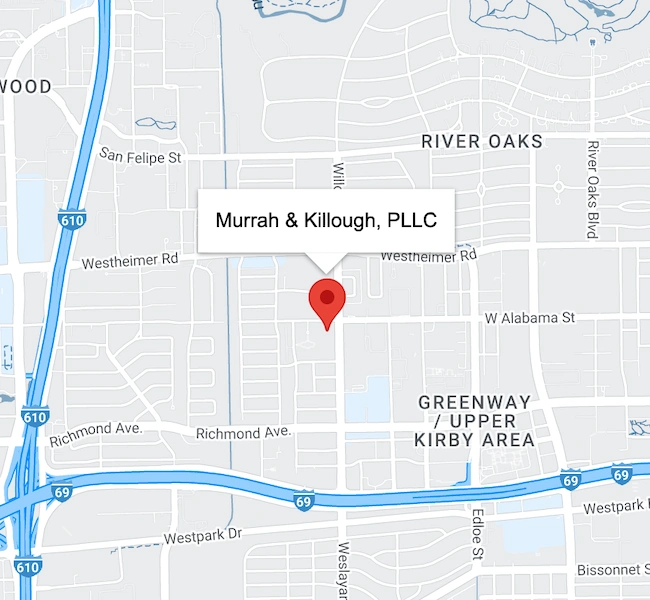
Houston Office
3000 Weslayan St.
Suite 305
Houston, Texas 77027
Phone
281-501-1601
Copyright © 2026 Murrah & Killough, PLLC. All rights reserved.
