

- About Us
- Business Law
- Civil & Commercial
- Family Law
- Resources
- Contact
Texas Breach of Fiduciary Duty Attorney
 Serving the Greater Houston Area
When someone in Texas fails to fulfill their fiduciary responsibilities, it can lead to significant issues. This could involve a trustee mismanaging estate funds, a company leader engaging in self-serving deals, or a partner disclosing confidential information inappropriately. Such actions can result in serious legal complications.
For instance, consider a healthcare company suffering financial losses because a board member failed to disclose a conflict of interest. In such scenarios, having an experienced business litigation lawyer is crucial to navigating the legal system and ensuring justice is served.
If you suspect someone has breached their fiduciary duty, seeking legal advice immediately is essential. At Murrah & Killough, PLLC, we protect our client’s best interests and give every case the personal attention it deserves. We are committed to strong representation, focusing on reducing risks and achieving our clients’ objectives. Acting as an external general counsel, Murrah & Killough, PLLC provides a wide range of services to oversee the legal aspects of running a business. We ensure that individuals in fiduciary positions perform their duties correctly and address any misconduct with seriousness.
Contact Murrah & Killough, PLLC at 281-501-1601 for the legal support you need.
Understanding Fiduciary Duty in Texas Law
Fiduciary duty in Texas law is a legal and ethical responsibility that someone or an organization has to act in the best interest of another person or group, especially when that person or group relies on their expertise and trustworthiness. This duty includes several responsibilities, like the duty of loyalty, which means the fiduciary should always put the beneficiary’s interests before their own, and the duty of care, which requires them to act carefully and thoughtfully, as any sensible person would do in the same situation. These duties are important in many professional relationships, such as between lawyers and their clients, people managing others’ assets, and company leaders working for their shareholders.
The Texas Supreme Court has long recognized the importance of fiduciary duties, closely monitoring the ethical behavior expected in these relationships. In Texas, a fiduciary is expected to act with the highest honesty and integrity, avoiding any deceit, fraud, and self-centered behavior for the good of the beneficiary. It’s a role that requires more than just following professional standards; it’s about a deep commitment to put someone else’s interests first.
Common Scenarios Leading to Breach of Fiduciary Duty Litigation
When fiduciary relationships are compromised, it can lead to a range of legal challenges. Here are some typical situations that often result in breach of fiduciary duty litigation:
- Conflicts of Interest: A fiduciary acts in their own interest rather than in the best interest of the beneficiary or the organization they serve.
- Mismanagement of Assets: A fiduciary makes poor investment choices or misuses funds, which can result in significant financial losses for the beneficiary.
- Self-Dealing: A fiduciary engages in transactions that benefit themselves at the expense of the beneficiary or the organization.
- Neglect of Duties: A fiduciary fails to perform their responsibilities with the care and diligence required, leading to harm or loss.
- Unauthorized Disclosure: A fiduciary shares confidential information without permission, which can damage the beneficiary’s position or interests.
- Fraudulent Acts: A fiduciary intentionally deceives or misleads the beneficiary for personal gain.
- Failure to Disclose: A fiduciary does not provide all necessary information to the beneficiary, leading to uninformed or harmful decisions.
Identifying a Breach of Fiduciary Duty: What’s Next?

Once a breach of fiduciary duty is identified, immediate action is required. Here are the steps to follow:
- Document The Breach: Record all evidence of the fiduciary’s failure to uphold their duty.
- Review Fiduciary Agreements: Check the documents that outline the fiduciary’s responsibilities.
- Notify Involved Parties: Inform all beneficiaries or stakeholders of the potential breach.
- Consult an Attorney: Seek legal advice to understand the implications and options available.
- Consider Mediation: Before filing a lawsuit, explore if the dispute can be settled through mediation.
- File a Lawsuit: If necessary, initiate legal proceedings to address the breach and seek remedies.
- Collect Evidence: Gather all relevant documentation, financial records, and witness statements.
- Prove the Breach: Show that the fiduciary had a duty, breached that duty, and caused damages.
- Seek Remedies: Pursue compensation for losses or other appropriate legal remedies.
The Legal Process for Fiduciary Duty Claims in Texas
In Texas, the legal process of a breach of fiduciary duty begins with the filing of a lawsuit, a step that signals the formal examination of a fiduciary duty claim.
The plaintiff must:
- Confirm there’s a fiduciary relationship
- Show the fiduciary didn’t act as they should have
- Link the breach directly to the losses
Time is also an important factor, as Texas law sets a four-year limit to take legal action.
Investigation and Evidence Gathering
In legal disputes, evidence is key to proving a case. In a fiduciary duty claim, it’s important to gather all the evidence that shows the fiduciary didn’t do their job. This step helps to make the case against the fiduciary clear and strong, based on solid facts.
The evidence should clearly show that there was a fiduciary relationship and that it was broken by the fiduciary’s actions. It could be financial records that show wrong dealings or emails that show the fiduciary was not acting in the best interest of the client. All these pieces of evidence are important to show where the fiduciary went wrong. This careful work helps to bring the issue to light and prepare it for a decision in court.
Crafting a Compelling Case
 Winning a legal case often hinges on presenting a clear and persuasive story. The story begins with establishing the existence of a fiduciary relationship, which could be explicitly stated in a contract or implied by the nature of the interaction between the involved parties. In cases involving fiduciary duties, the person bringing the lawsuit needs to build a convincing argument that leaves no room for doubt.
To prove that a fiduciary failed to uphold responsibilities, you must show how they strayed from their obligations, either through carelessness or deliberate actions that served their own interests. The person bringing the lawsuit must clearly demonstrate how these actions not only violated the fiduciary’s duty but also resulted in actual harm or financial loss, establishing a direct link.
The last step involves putting a monetary value on the harm caused by the fiduciary’s actions. This requires careful analysis to understand the full extent of the loss and any benefits the fiduciary may have gained improperly. At Murrah & Killough, PLLC, our Texas business litigation lawyers ensure that our client’s stories are told persuasively and that every effort is made to restore what was lost due to the breach.
Remedies and Resolution
After a breach of fiduciary duty, it’s about fixing things and making amends. Money compensation is often the first step in making up for clear losses and penalizing for particularly harmful acts.
The law also offers non-monetary solutions, such as:
- Injunctions: A court order that requires a fiduciary to stop doing something harmful to the beneficiary’s interests.
- A Full Accounting: A detailed report of all financial transactions and decisions made by the fiduciary, to be reviewed for accuracy and honesty.
- Rescission: The cancellation of a transaction or contract that involved a breach of fiduciary duty, restoring the parties to their original positions.
- Profit Disgorgement: The act of giving up profits that were made through the breach of fiduciary duty, ensuring that the fiduciary does not benefit from their wrongful actions.
To get these solutions, it’s important to prove that a fiduciary was self-serving; there needs to be a clear link between their actions and the harm done.
Contact Murrah & Killough, PLLC to Protect Your Interests
If you’re facing a breach of fiduciary duty or require legal guidance to protect your interests, take the first step toward resolution by contacting Murrah & Killough, PLLC. Our firm understands the complexities and sensitivities involved in cases of breach of fiduciary duty. We are dedicated to thoroughly investigating your situation, identifying potential risks, and developing a strategic plan tailored to your specific needs. Our goal is to minimize your exposure to legal and financial liabilities while working towards a favorable outcome.
 At Murrah & Killough, PLLC, we pride ourselves on our client-centric approach. We believe that effective communication and collaboration are the keys to successful legal representation. Our team will work closely with you to understand your unique circumstances, answer your questions, and keep you informed at every stage of the legal process. We are committed to providing clear, practical advice and strong advocacy to help you achieve your desired results.
Don’t face your legal challenges alone. Let Murrah & Killough, PLLC be your trusted partner in navigating the complexities of fiduciary duty and protecting your business interest in partnership and shareholder conflicts.
Don’t let legal challenges overwhelm you—reach out to us at 281-501-1601 and let us help you secure the justice you deserve.




Contact Our Team Today!
Fields Marked With An “*” Are Required
"*" indicates required fields

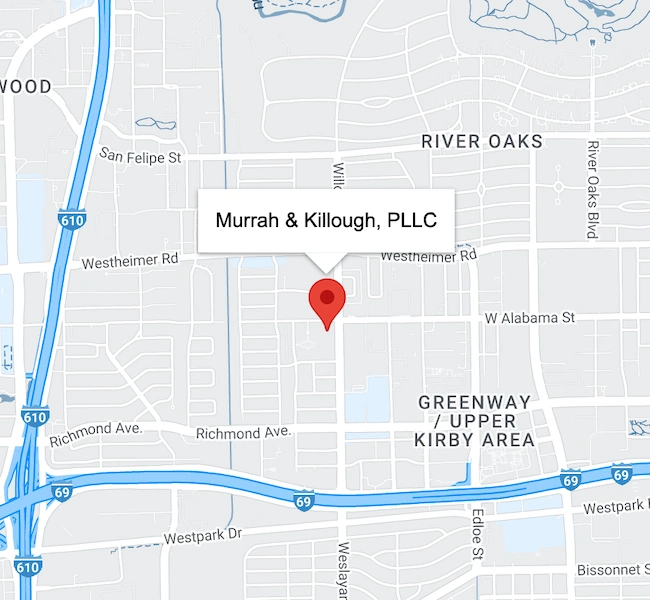
Houston Office
3000 Weslayan St.
Suite 305
Houston, Texas 77027
Phone
281-501-1601
Copyright © 2026 Murrah & Killough, PLLC. All rights reserved.
