

- About Us
- Business Law
- Civil & Commercial
- Family Law
- Resources
- Contact
Houston Retirement & Pension Division Attorney
Seeking Fair Division of Retirement Funds in Divorce Matters
 Divorce can make the future feel shaky, especially when part of that future is held in a 401(k), pension, IRA, or government retirement plan. Many people in Houston do not realize how much of a marriage’s value is tied up in benefits that will not be paid for years. That is why the division of retirement benefits deserves close attention before a decree is signed.
Texas law does not treat benefits as an afterthought. Property owned during marriage is generally presumed to be community property, and in a divorce, the court must divide the marital estate in a manner it considers just and right.
At Murrah & Killough, PLLC, we will do everything we can to help you obtain your fair share of benefits. You can contact us online or give us a call at (281) 501-1601 for a confidential case review.
Why Retirement Fund Division Is Complicated
Retirement accounts often look simple on paper, but the details can significantly affect their value. A pension may depend on years of service, vesting dates, and future payout choices. A 401(k) may have loans, market swings, and tax issues. A public employee plan may follow special state rules that do not match a private plan.
Texas also separates some retirement interests by time. Benefits earned during marriage may be community property, while benefits tied to service before marriage may remain separate property. To overcome the community property presumption, separate property must be properly traced and proven by clear and convincing evidence.
Common challenges include:
- Premarital balance claims: A spouse may say part of the account is separate, but that usually requires records that clearly show what existed before marriage.
- Plan type confusion: Pension, IRA, 401(k), and state retirement system plans may each require a different method of division.
- Tax surprise: A split that looks even on paper may not feel even after taxes and penalties are considered.
- Delayed paperwork: A decree alone may not move money from one spouse to the other.
Retirement Division Court Orders
Many retirement plans need a separate order after the divorce decree. For private employer plans, that often means a qualified domestic relations order, commonly called a QDRO. Texas Family Code § 9.101 allows a party to return to court for a QDRO or similar order related to retirement benefits, and Texas Government Code § 804.003 governs domestic relations orders for many public retirement systems.
A divorce decree may award part of a plan, but the plan administrator still needs language that it can accept. If the wording is off, if the order is never submitted, or if a spouse retires or dies before the paperwork is finished, the fight can get harder and more expensive.
In Harris County, family matters are handled through the family courts and related filing offices at the Civil Courthouse in downtown Houston. That local setting matters because retirement division often turns on clean pleadings, accurate decrees, and prompt follow-through after the final hearing.
Fair Division of Property in Texas
A fair result in Texas property division is not always a perfect half. Courts use a just and right standard, which means the split can vary based on the facts. Retirement benefits may be divided by percentage, by a set dollar amount, or by offsetting one asset against another. One spouse might keep more of a pension while the other keeps more equity in a house or more liquid savings.
A Houston retirement & pension division attorney can help determine what is actually marital, what is separate, and what language the plan will require before any transfer occurs. That work matters just as much in a calm divorce as it does in a hard-fought one.
Useful questions to ask early include:
- Vesting status: Has the benefit fully vested, or is part of its value still uncertain?
- Survivor benefits: Will the order protect payments if the spouse receiving employee benefits dies first?
- Loan balance: Has money already been borrowed from the account, reducing what is left to divide?
- Post-divorce growth: Will gains and losses after a certain date be included in the split?
Why Families Turn to Our Firm
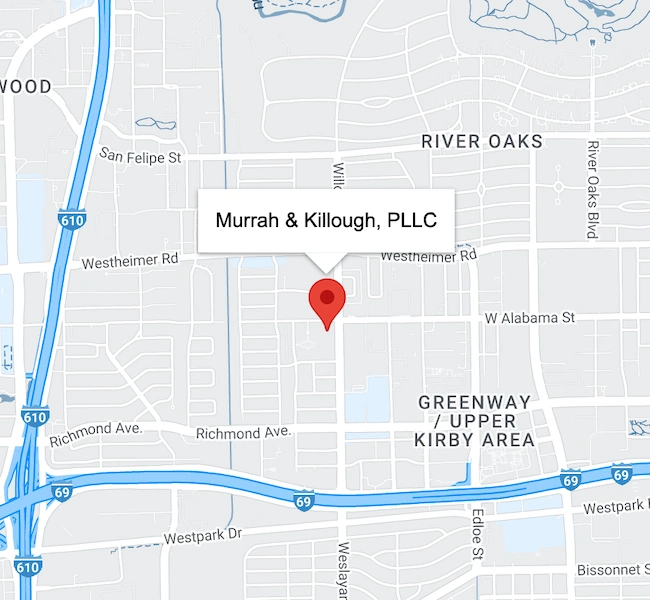
Murrah & Killough, PLLC, serves Houston families from our office on Weslayan and handles divorce and property division matters involving retirement accounts and other substantial assets. Our firm’s family law attorneys work with retirement division, tax-sensitive asset issues, and tailored case planning rather than offering one-size-fits-all advice.
Our Houston retirement & pension division attorneys handle both the real-life and legal aspects of the case. We look at the plan itself, the timeline of the marriage, the decree language, and the follow-through needed after judgment so a paper award has a real chance of becoming an actual payment.
Frequently Asked Questions
Can a Spouse Get Part of a Retirement Account Even if the Account Is Only in One Name?
Yes. The title alone does not decide the issue in Texas. If part of the benefit was earned during marriage, that portion may be subject to division. The key question is when the benefit was earned, not whose name is on the account. A proper tracing of the account’s history is often necessary to determine what is marital and what is separate.
Are Texas Government Pensions Handled the Same Way as Private Employer Plans?
Not always. Public plans can follow their own statutory rules and review procedures, so the order must fit that system. Texas law treats many public retirement systems differently from private employer plans, and the requirements can differ significantly. Working with an attorney familiar with both types of plans can help avoid costly errors in the order language.
Protect Your Share Before the Decree Is Final
Retirement mistakes in divorce can stay with you for years. If you need clear advice from a Houston retirement & pension division attorney, Murrah & Killough, PLLC can evaluate the account, the order, and the steps needed to protect your financial future before the decree is signed. If you would like a confidential consultation with one of our lawyers, please use our online form or call (281) 501-1601.




Contact Our Team Today!
Fields Marked With An “*” Are Required
"*" indicates required fields

Houston Office
3000 Weslayan St.
Suite 305
Houston, Texas 77027
Phone
281-501-1601
Copyright © 2026 Murrah & Killough, PLLC. All rights reserved.
