

- About Us
- Business Law
- Civil & Commercial
- Family Law
- Resources
- Contact
Our Blog Post
Can I Sue a Financial Advisor?

When you hire a financial advisor, you trust them to act in your best interest, manage your investments carefully, give sound advice, and protect your financial future. Unfortunately, not every advisor meets those expectations. If negligence, misrepresentation, or misconduct leads to financial loss, you may have the right to take legal action.
Murrah & Killough, PLLC, helps clients throughout Houston and across Texas pursue claims against financial professionals who breach their duties. If you believe your financial advisor’s actions caused you harm, here’s what you need to know about your legal options.
Understanding Your Financial Advisor’s Legal Duties
Financial advisors owe clients certain legal and ethical obligations. These duties depend on the type of professional and the nature of your relationship. Generally, advisors must:
- Act in good faith and put the client’s interests ahead of their own;
- Disclose all relevant information about investment risks, fees, and conflicts of interest;
- Provide suitable recommendations that align with the client’s goals, risk tolerance, and financial situation; and
- Follow the law and industry regulations established by the Securities and Exchange Commission (SEC), the Financial Industry Regulatory Authority (FINRA), and the Texas State Securities Board.
When an advisor violates these duties, their conduct can lead to serious financial losses and potential legal liability.
Common Reasons to Sue a Financial Advisor
Not every poor investment outcome means your financial advisor did something wrong. Investments naturally carry risks. However, you may have a valid legal claim if your losses resulted from unethical or illegal conduct.
Here are some of the most common grounds for lawsuits against financial advisors in Texas:
Negligence
If your advisor failed to exercise reasonable care or skill in managing your investments, and that failure caused losses, you may be able to sue for negligence. Examples include making unsuitable recommendations or failing to diversify your portfolio.
Breach of Fiduciary Duty
Some advisors, such as Registered Investment Advisors (RIAs), are fiduciaries. This means they are legally bound to act solely in your best interest. If your advisor prioritized their own commission, ignored your instructions, or concealed conflicts of interest, they may have breached this fiduciary duty.
Misrepresentation or Fraud
If your advisor made false statements or intentionally misled you about an investment’s risk or expected returns, you could have a claim for fraud or misrepresentation. Even exaggerating performance data or omitting key facts can lead to liability.
Unauthorized Trading
Financial advisors are not allowed to buy or sell securities without your consent, unless you’ve given them written discretionary authority. Unauthorized transactions may violate both your agreement and state or federal law.
Excessive Trading (Churning)
If your advisor made frequent trades primarily to generate commissions instead of benefiting your portfolio, this is known as “churning.” It’s unethical and potentially actionable under Texas and federal securities laws.
Failure to Supervise
Brokerage firms and investment companies have a duty to supervise their employees. If a firm failed to monitor an advisor’s conduct and that led to your losses, the firm itself may also be liable.
How to Prove Your Case
To prove a claim against a financial advisor, you must show that their misconduct directly caused your financial loss. This usually involves:
- Establishing the advisor’s duty of care or fiduciary duty;
- Demonstrating that they breached that duty;
- Linking the breach to your financial loss; and
- Calculating the damages, typically, the money you lost due to their misconduct.
Claims against financial advisors often rely on detailed documentation, including account statements, trade confirmations, emails, and notes from meetings. Because these claims can be technical, working with an attorney familiar with Texas business and securities law is essential.
At Murrah & Killough, PLLC, we review investment records, identify regulatory violations, and work with financial experts when necessary to strengthen your case.
Arbitration vs. Lawsuit: How These Cases Are Resolved
Many financial advisor disputes are subject to mandatory arbitration through FINRA or another arbitration forum. When you opened your account, you may have signed an agreement requiring arbitration instead of traditional litigation.
Arbitration can be faster and less formal than going to court, but it’s still a legal proceeding. You’ll need to present evidence, witness testimony, and expert analysis to support your claim. In some cases, a lawsuit in Texas state court may still be possible, particularly when the advisor is not FINRA-registered or the misconduct involves additional legal claims such as breach of contract or fraud.
An experienced Houston attorney can help determine whether your claim belongs in arbitration or court, and how best to pursue recovery.
Potential Compensation
If your case succeeds, you may recover:
- Investment losses directly tied to the advisor’s misconduct;
- Lost profits you would have earned with proper management;
- Out-of-pocket costs associated with the misconduct;
- Attorney’s fees and arbitration expenses (when permitted); and
- In some cases, punitive damages are awarded for intentional wrongdoing or fraud.
Every case is unique. The amount of recovery depends on the size of your losses, the nature of the misconduct, and the evidence available.
How Murrah & Killough, PLLC Can Help
If you believe your financial advisor acted improperly, you deserve to know your options. Our Houston-based team provides strategic legal representation for clients seeking accountability and compensation.
At Murrah & Killough, PLLC, we handle claims involving:
- Investment fraud and misrepresentation;
- Breach of fiduciary duty;
- Negligent financial advice;
- Unauthorized trading or account activity; and
- Brokerage and firm supervision failures.
We represent individuals, business owners, and fiduciaries such as trustees who rely on financial professionals to manage significant assets. Our Houston business and investment attorneys act as your outside general counsel, offering honest, practical advice focused on protecting your wealth and long-term financial health.
Whether your claim proceeds through arbitration or litigation, we are committed to pursuing a fair resolution and holding negligent financial professionals accountable.
Contact Murrah & Killough, PLLC for skilled business law litigation.
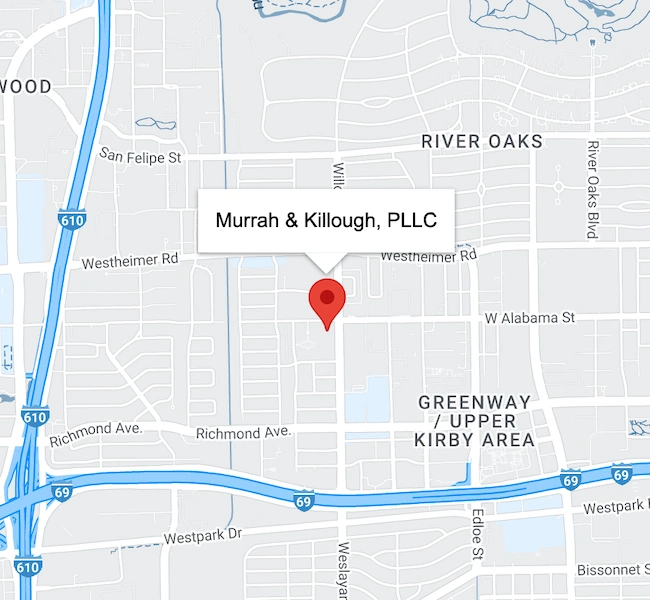
Contact the experienced lawyers at Murrah & Killough, PLLC today & schedule your free consultation. We proudly serve Houston, & all throughout Texas. Visit our law offices at:
Our Houston Office
3000 Weslayan St. Suite 305
Houston, Texas 77027
Phone: (281) 501-1601
Contact Our Team Today!
Fields Marked With An “*” Are Required
"*" indicates required fields

Houston Office
3000 Weslayan St.
Suite 305
Houston, Texas 77027
Phone
281-501-1601
Copyright © 2026 Murrah & Killough, PLLC. All rights reserved.
