

- About Us
- Business Law
- Civil & Commercial
- Family Law
- Resources
- Contact
Can My Business Partner Push Me Out?
 Business relationships often begin with aligned objectives and mutual enthusiasm, but disagreements can arise as operations progress and circumstances change. When these conflicts intensify, you might question whether your co-owner possesses the authority to remove you from the enterprise you helped build.
If a partner acts unilaterally, disrupts operations, or becomes uncooperative, Texas law provides remedies. Our attorneys can guide you through your legal options and provide you with the necessary protections. Call Murrah & Killough, PLLC, at (281) 501-1601 to schedule a consultation with an experienced Houston business law attorney who can evaluate your circumstances and protect your ownership interests.
Can My Business Partner Push Me Out?
 Depending on your ownership structure, agreement terms, and applicable laws, partners in Texas may potentially force your exit from the business under certain circumstances. Your vulnerability to removal depends primarily on your company’s governing documents, including partnership agreements or operating agreements, as well as applicable provisions of Texas statutes.
When your organization has comprehensive buy-sell agreements that specify triggering events, your partner may have the legal authority to compel a buyout under those predetermined terms.
Texas State Law
The Texas Business Organizations Code, Section 152.501, establishes statutory grounds for partner dissociation when agreements do not contain provisions for the removal of partners. It identifies specific situations that justify involuntary partner removal:
- Express the will of all other partners when no definite term exists.
- Judicial determination based on partner misconduct.
- The partner becomes legally incapacitated.
- The partner files for bankruptcy.
- The partner commits a material breach of the partnership agreement.
- The partner engages in wrongful conduct that affects the business.
- The partner makes continuation of the partnership impracticable.
Factors Determining if You Can Be Pushed Out
Multiple elements influence whether your partner can remove you from your business. We understand these factors and can help you assess your vulnerability and develop appropriate protective strategies.
Partnership Agreement
Reviewing your partnership agreement is the first step in understanding removal procedures and available protections. Strong agreements usually include clear provisions for forced exits:
- Specific grounds justifying partner removal.
- Voting thresholds required to expel a partner.
- Valuation methods for determining buyout prices.
- Payment terms and timing for forced buyouts.
- Dispute resolution procedures, including mediation or arbitration requirements.
- Notice requirements before removal proceedings.
- The right to cure breaches before forced exit.
Breach of Duty or Misconduct
Partners owe fiduciary duties to each other and the business, including duties of loyalty and care as outlined in Section 152.204 of the Texas Business Organizations Code. When you breach these duties through self-dealing, competition with the partnership, misappropriation of opportunities, or gross negligence, your partner may have grounds to pursue removal even without explicit agreement provisions.
Lack of a Written Agreement
Operating without written partnership agreements leaves questions about removal to statutory default rules. Texas Business Organizations Code Title 4, Section 152 addresses partnerships without comprehensive agreements:
- Partner dissociation upon the express will of the majority.
- Judicial dissolution for partner misconduct.
- Dissolution when business becomes impracticable.
- Expulsion based on unlawful conduct.
- Removal following a material breach of the agreement.
How Murrah & Killough, PLLC Can Help
Our firm provides comprehensive representation for partners facing removal attempts or seeking to protect their business interests during disputes. We combine thorough knowledge of Texas business law with practical experience handling partnership conflicts to help achieve favorable outcomes for our clients.
Analyzing Your Legal Position
We examine your partnership agreements, business structure, and circumstances surrounding removal attempts to determine your legal protections and vulnerabilities. Our analysis identifies procedural defects in removal efforts, evaluates the validity of alleged grounds for expulsion, and assesses the strength of your position.
Negotiating a Resolution
At Murrah & Killough, PLLC, we strive to resolve partnership disputes through negotiation or mediation whenever possible, pursuing resolutions that compensate you fairly for your ownership interest while minimizing the need for extended litigation. Skilled negotiation often produces better outcomes than courtroom battles, preserving business value and reducing legal expenses.
Pursuing Legal Action
When negotiation fails or partners act unlawfully, we pursue litigation to protect your rights and recover damages. Available legal actions include:
- Sue for Breach of Contract: Our attorneys file lawsuits when partners violate the terms of their agreement, including removal procedures, buyout terms, or payment obligations. Breach of contract claims seek damages to compensate for losses resulting from violations and may support requests for specific performance, which requires compliance with contractual terms.
- Sue for Breach of Fiduciary Duty: We assert claims when partners breach their fiduciary obligations through self-dealing, usurpation of opportunities, or oppressive conduct designed to force your exit at unfair prices. Fiduciary breach claims may support additional damages and equitable remedies.
- Petition for Judicial Dissolution: We seek court-ordered dissolution when partners make business continuation impracticable through misconduct, deadlock, or oppressive actions. Dissolution proceedings address asset distribution, debt allocation, and business wind-down while protecting your interests.
Contact Murrah & Killough, PLLC for skilled business law litigation.
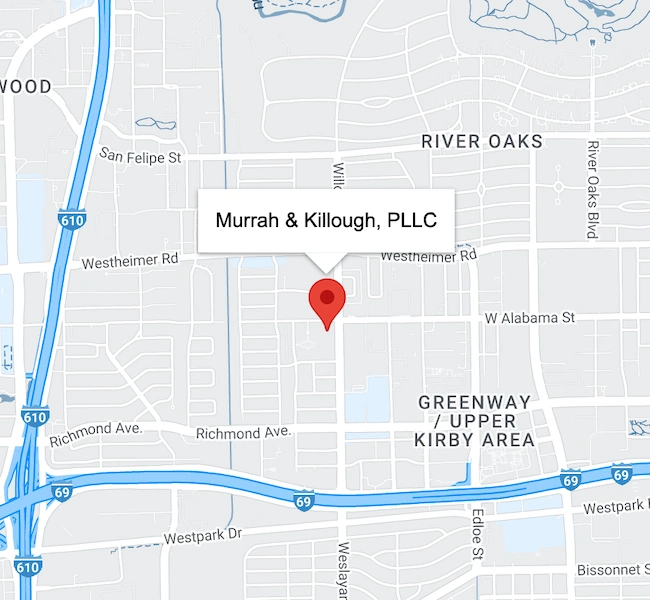
Contact the experienced lawyers at Murrah & Killough, PLLC today & schedule your free consultation. We proudly serve Houston, & all throughout Texas. Visit our law offices at:
Our Houston Office
3000 Weslayan St. Suite 305
Houston, Texas 77027
Phone: (281) 501-1601




Contact Our Team Today!
Fields Marked With An “*” Are Required
"*" indicates required fields

Houston Office
3000 Weslayan St.
Suite 305
Houston, Texas 77027
Phone
281-501-1601
Copyright © 2026 Murrah & Killough, PLLC. All rights reserved.
