

- About Us
- Business Law
- Civil & Commercial
- Family Law
- Resources
- Contact
Houston Property Division Lawyer
Experienced Legal Guidance for Property and Asset Divisions
 Going through a divorce and worried about how your assets will be divided? A Houston assets division lawyer can help ensure a fair distribution of property. At Murrah & Killough, PLLC, we understand how important it is to protect your financial future and are here to provide the practical support and legal guidance you need during this time.
Our team of Houston asset division lawyers is committed to helping you through the process of dividing marital property, ensuring that your rights and interests are protected. We focus on delivering clear, strategic solutions tailored to your unique situation, allowing you to move forward with confidence.
If you are ready to discuss your case and explore your options, reach out to Murrah & Killough, PLLC today. Let us assist you in securing a fair and equitable division of your assets.
Murrah & Killough, PLLC is ready to help. Call (281) 501-1601 or contact us online to schedule a confidential case evaluation.
Division of Property in Divorce
What Texas Courts Examine Before a Decree Is Signed
Property division can affect your finances for years after a Texas divorce. A house, retirement account, business interest, debt balance, or even a reimbursement claim can become part of the negotiations, so it is important to know how Texas courts approach these decisions before you agree to anything.
Texas follows community property rules, but that does not mean every case ends with a perfect half-and-half split. A court must divide the marital estate in a manner it considers “just and right” under the law, which gives judges room to weigh fairness, fault, earning power, and the facts tied to each family.
What Counts as Community Property in Texas?
Texas law treats most property acquired during marriage as community property under Texas Family Code § 3.002. That can include wages, savings, real estate bought during marriage, retirement benefits earned during marriage, and many debts created during the relationship. Under Texas Family Code § 3.003, property in either spouse’s possession at the time of divorce is presumed to be community property unless someone proves otherwise.
Separate property is treated differently. Under Texas Family Code § 3.001, it generally includes:
- Property owned before marriage: A home, land, account, or other asset one spouse already had before the wedding.
- Gifts and inheritances: Money or property received by one spouse alone during marriage.
- Certain personal injury recoveries: Parts of a personal injury award may remain separate, except for compensation tied to lost earning capacity during marriage.
A title document does not always settle the issue. A car, bank account, or piece of land can still be community property even if only one spouse’s name appears on it, which is why records matter so much in these cases.
Why a Texas Court May Not Split Things Evenly
The just and right standard under Texas Family Code § 7.001 gives the court flexibility. In some divorces, one spouse may receive a larger share of the community estate based on the facts presented to the judge. Common issues that can affect division include:
- Earning power: A spouse with much lower future income may argue for a larger share.
- Fault in the breakup: Texas courts may consider fault when dividing community property.
- Waste or fraud: If one spouse hid, spent, or transferred assets unfairly, the court may adjust the division.
- Size of separate property estates: A judge may look at what each spouse will leave the marriage with overall.
What Happens to the House, Debts, and Retirement Accounts?
A family home is often the most emotional asset, but the court must still treat it as part of the estate analysis. One spouse may keep the home, the house may be sold and the proceeds split, or the parties may offset the home’s value with other assets. Retirement accounts, stock options, business interests, and valuable collections are treated the same way.
Debt is also part of the equation. Mortgages, credit cards, tax debt, business loans, and personal loans can all become part of the property division conversation. A decree may assign a debt to one spouse, but lenders are not automatically bound by that divorce order, which means careful planning before settlement is important.
Why Families Turn to Murrah & Killough, PLLC
What you walk away with after a divorce shapes your financial future and your peace of mind. At Murrah & Killough, PLLC, we treat property division as exactly that important. We handle divorce, family law disputes, and asset division matters for clients in the Houston area, focusing on practical strategies grounded in the facts of the marriage and the financial record. We can work through tracing issues, disputed valuations, and claims that a spouse concealed assets or misused community funds, and we are prepared to litigate when settlement is not enough.
Understanding Community and Separate Property in Texas
Texas operates under a community property state system, which means that most assets acquired during the marriage, including any property acquired, are considered community property and jointly owned by both spouses.
This includes the family home, cars, bank accounts, and even household items. However, not all property falls under this category.
Separate property, on the other hand, includes assets obtained before the marriage or those acquired by inheritance or gift.
The process of property division in Texas is governed by the Texas Family Code, which emphasizes a fair distribution of assets. This means that the division of property is based on what the court deems fair, taking into account various factors such as the duration of the marriage and each spouse’s financial contributions, as outlined in Texas family law.
The distinction between community and separate property is important during a divorce. According to Texas law, the burden of proof is on the individual claiming an asset as separate property, requiring clear and convincing evidence.
This is where the help of a Houston property division attorney becomes invaluable. They can assist you in gathering the necessary proof to ensure your separate property is protected.
Factors Influencing Equitable Property Division
When determining property division, Texas courts consider various factors to ensure an equitable distribution:
- Length of the Marriage: Longer marriages often result in more substantial financial entanglements.
- Financial Contributions: The income and homemaking efforts of each spouse during the marriage are assessed.
- Earning Potential: This affects the financial stability of each spouse post-divorce.
- Custody Arrangements: These can significantly alter the court’s assessment of financial needs.
- Asset and Debt Identification: Proper valuation of all assets and debts is crucial.
- Hidden Assets: The presence of hidden assets can impact the division process.
- Non-Tangible Assets: Allocation of assets like intellectual property is considered.
- Spousal Misconduct: The court may adjust asset division based on a spouse’s misconduct during the marriage.
These factors affect how property is divided because they give the court a clear picture of the marriage’s financial and personal situation. Understanding these factors helps people prepare for property division and protect their interests.
Requirement to Disclose
A full and truthful disclosure of financial information from both spouses must legally precede any property division between spouses. The disclosure must cover income details and assets such as real estate holdings, bank account balances, investments, debts, and any additional property obtained during the marital union. Unfortunately, not all people follow these requirements honestly and properly. Legal measures become necessary when one party hides information or provides false documentation.
Common Challenges in Asset Division
Dividing marital property can be a complicated and emotional task, often leading to questions about who owns what and what is fair. Some typical problems include hidden assets, disagreements during negotiations, and the overall difficulty of the process. These issues can sometimes result in legal disputes and feelings of unfairness during divorce proceedings.
To better understand what might come up, here are some common challenges faced during asset division:
- Hidden Assets: Sometimes, a spouse might try to hide assets to keep from sharing them, making the division process more difficult.
- Valuation Disputes: Figuring out the true value of assets, especially complex ones like businesses or retirement accounts, can lead to disagreements.
- Ownership Conflicts: Arguments over whether certain assets are shared or belong to one person can arise, affecting how they are divided.
- Emotional Strain: The stress of divorce can make conflicts worse and negotiations harder.
- Negotiation Issues: Coming to an agreement can be tough, especially if one spouse is not willing to cooperate.
- Legal Complexities: Understanding Texas property division laws can be tricky, and it’s important to ensure fairness.
Being aware of potential problems and working with a knowledgeable property division attorney can help clients deal with these issues more effectively and reach a fair division of assets.
How Key Assets Are Divided
The division of specific assets involves several considerations beyond ownership determination. The following describes the standard approach courts take when dividing critical asset categories:
- Real Estate: The real estate asset is usually sold. Proceeds are split between spouses or refinanced by one spouse, who then buys out their partner.
- Retirement Accounts: The division of retirement accounts requires a Qualified Domestic Relations Order (QDRO) to prevent penalties.
- Business Interests: Ownership of business interests can be settled through valuation. One spouse retains the business ownership, and the other spouse has a corresponding value offset.
- Debts: Courts may allocate community debts, such as mortgages and credit cards, based on the debtor’s ability to pay. These debts are typically divided between spouses.
What Happens to Debt Division During Divorce?
 In Texas, when a couple divorces, debts are divided just like assets. Since Texas is a community property state, debts taken on during the marriage are generally seen as shared responsibilities.
This means both spouses are usually responsible for any debt accumulated while married, no matter whose name is on the account.
Steps in the Property Division Process

Initial Consultation
The process begins with a consultation, where the lawyer reviews the case and outlines strategies. This gives clients a clear picture of their options and possible outcomes.
Identifying and Valuing Assets
All marital property, such as real estate, accounts, and investments, must be identified and valued. Co-mingled funds and complex assets like businesses or retirement accounts may require expert appraisal, which can delay the process.
Negotiation and Settlement
Most cases aim for a negotiated settlement that the court will approve. If no agreement is reached, the court decides. Attorneys work to secure fair outcomes while helping clients avoid the uncertainty of litigation.
The Role of a Houston Assets Division Lawyer
A Houston property division lawyer helps clients understand and manage the process of dividing marital assets. They work to protect their clients’ rights and interests throughout the process. These Houston asset division attorneys explain Texas law regarding asset classification.
The main duties of these lawyers include:
- Protecting retirement benefits and finding hidden assets to ensure a fair division.
- Handling complex asset division cases, especially for clients with significant wealth, to achieve fair outcomes.
- Explaining the differences between community and separate property.
- Helping to accurately assess the value of marital assets, including businesses and retirement accounts.
- Assisting in reaching agreements and settlements that benefit their clients.
- Providing legal advice to protect clients’ financial interests during divorce.
Working with a divorce attorney helps clients understand the legal process and achieve a fair division of their marital assets.
Protecting Your Interests During Asset Division
Hiring an asset division lawyer safeguards your interests in assets and retirement benefits during a divorce. Consulting with an experienced attorney ensures that assets are divided fairly, taking into account all legal nuances.
Divorce property division lawyers are skilled in protecting personal property entitlements and addressing tax responsibilities.
These attorneys guide clients through negotiating fair property settlements, using tailored strategies such as mediation, negotiation, and litigation to protect their clients’ interests.
FAQ: Common Questions About Property Division in Texas
Can a Spouse Spend Money Freely Once a Divorce Is Filed?
Not safely. Once a divorce is pending, spending patterns often come under a microscope, and unusual withdrawals or transfers can become evidence in court. Courts have tools to address fraud on the community when property was unfairly depleted before or during the proceedings.
Do We Need to Go to Trial to Divide Property?
Not always. Under Texas Family Code § 7.006, spouses can enter into a written agreement incident to divorce, and many cases resolve through negotiation or mediation before trial. The final agreement still needs to meet legal requirements and be approved by the court.
Can a Business Started During Marriage Stay With One Spouse?
Yes, but ownership and value still have to be addressed. One spouse may keep the business while the other receives other assets, a structured payout, or other terms in the decree, depending on valuation evidence and the rest of the estate.
Why Choose Murrah & Killough, PLLC for Asset Division
At Murrah & Killough, PLLC, we focus on giving you personal attention to make sure your interests come first during the asset division process. With 30 years of combined experience, our firm has a proven history of achieving strong results and satisfying clients. We offer a full range of services, including mediation and litigation, to cover all parts of asset division.
Our dedicated team of family law attorneys is committed to helping you achieve a fair property division. By choosing Murrah & Killough, PLLC, you gain access to professional legal representation and a caring approach to handling your divorce.
Get Answers From Our Texas Divorce Lawyers Before You Sign Away Property Rights
A property division mistake can stay with you long after the divorce is over. If your case involves real estate, retirement funds, a closely held business, unusual debt, or concerns about hidden assets, our team at Murrah & Killough, PLLC can review the facts, identify risks, and help you pursue a fair result before final orders are entered. Call (281) 501-1601 or contact us online for a confidential case evaluation.
Contact Our Team Today!
Fields Marked With An “*” Are Required
"*" indicates required fields

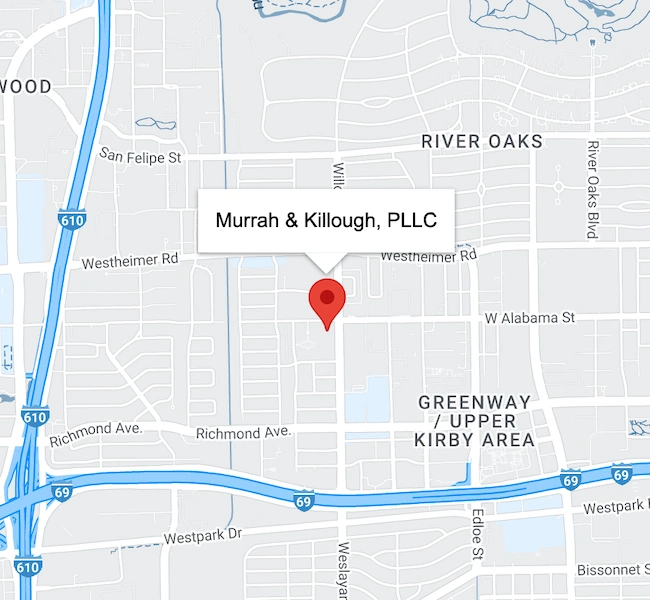
Houston Office
3000 Weslayan St.
Suite 305
Houston, Texas 77027
Phone
281-501-1601
Copyright © 2026 Murrah & Killough, PLLC. All rights reserved.
