

- About Us
- Business Law
- Civil & Commercial
- Family Law
- Resources
- Contact
How Are Assets Divided in a Divorce in Texas?
 Splitting assets during divorce proceedings is one of the greatest emotional and financial challenges spouses face when dissolving their marriage. Texas property division laws cover the distribution of homes, retirement accounts, debts, and personal possessions. Don’t leave your financial future to chance; get the guidance you need to move forward with confidence.
Call Murrah & Killough, PLLC, at 281-501-1601 to discuss how we can help protect what matters most.
Factors Influencing Asset Division
Texas courts distribute community property based on what is fair and equitable rather than splitting it evenly. The division between parties may not result in an exact 50/50 distribution. The court evaluates various elements to reach a fair property division.
- Each spouse’s earning capacity
- Each spouse’s health
- Each spouse’s education
- Whether or not one spouse has other children
- Any fault in the divorce
The subjective nature of these considerations demands a lawyer who can present your case effectively.
The Asset Division Process
Dividing property in a divorce can feel overwhelming, but Texas law provides a framework for the process. Here are the typical steps:
Step 1: Identify All Property and Debts
Both spouses must disclose everything they own and owe. This includes:
Bank accounts, investments, and retirement savings
Homes, vehicles, and real estate
Business interests
Credit cards, loans, and other debts
Full disclosure is critical. If property is hidden, the court may impose penalties.
Step 2: Classify Property as Community or Separate
Next, the court (or attorneys during negotiations) determines whether property is:
Community property – acquired during the marriage and subject to division.
Separate property – owned before marriage, or received as a gift/inheritance. Separate property belongs to the original owner and is not divided.
Step 3: Value the Property
Once classified, the property must be assigned a fair market value. This may involve appraisals, financial statements, or expert testimony—especially for homes, businesses, or retirement accounts.
Step 4: Divide Community Property and Debts
The court applies Texas’s “just and right” standard. This means the division should be fair, though not always equal. Factors like earning capacity, custody of children, and fault in the marriage may influence the split. Debts are divided in the same way as assets.
Step 5: Finalize Through Court Order or Settlement
Property division can be finalized in two ways:
Settlement Agreement – Spouses (through their attorneys) agree on how to divide property and debts. The agreement is then approved by the judge.
Court Order – If no agreement is reached, the judge decides and issues a final order.
Common Mistakes to Avoid
Even those who mean well can unknowingly make mistakes in the property division process. Some common mistakes to avoid include:
- Agreeing to the resolution too quickly. Even when you are offered a simple 50/50 split, take time to consider the true value of each asset and how it will affect you in the long term.
- Forgetting taxes and other fees. If you fail to consider taxes and other fees, this can result in a reduced value of assets.
- Overlooking retirement or investment accounts. These long-term assets can carry significant value, and failing to include them in the division can lead to an imbalanced settlement.
Contact Murrah & Killough, PLLC, Today
Murrah & Killough, PLLC, designs personalized strategies for each unique client. We team up with financial professionals, forensic accountants, and appraisers as necessary to guarantee an accurate and fair division of property. Our legal team values transparency and preparation while focusing on achieving results in both simple separations and complex disputes.
Murrah & Killough, PLLC, provides professional assistance to guide you toward financial autonomy with assurance and transparency. To schedule your consultation today, contact us at 281-501-1601.
Contact Our Team Today!
Fields Marked With An “*” Are Required
"*" indicates required fields

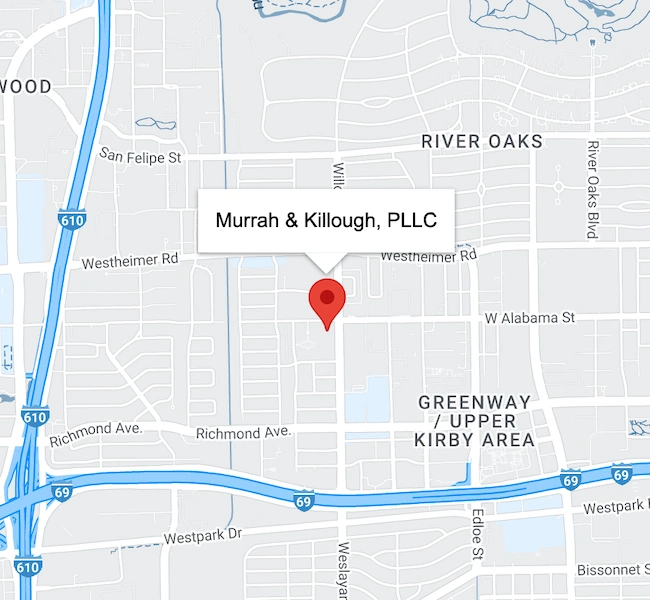
Houston Office
3000 Weslayan St.
Suite 305
Houston, Texas 77027
Phone
281-501-1601
Copyright © 2026 Murrah & Killough, PLLC. All rights reserved.
