

- About Us
- Business Law
- Civil & Commercial
- Family Law
- Resources
- Contact
Legal Guidance for Child Custody Modifications and Enforcement
 Child custody modification refers to the legal process of changing an existing custody arrangement due to significant changes in circumstances. Whether you’re facing a job relocation, changes in your child’s needs, or other life-altering events, having an experienced lawyer by your side is important.
At Murrah & Killough, PLLC, we focus on guiding families through the intricate process of child custody modifications and enforcement. Our dedicated family law attorney is here to provide personalized legal support tailored to your unique situation.
Don’t face this challenging time alone—reach out to our Houston child custody lawyer today at 281-501-1601 to schedule a consultation.
Understanding Child Custody Modifications in Houston
Child custody modifications in Houston follow Texas law, which requires a significant change in circumstances to alter an existing custody arrangement. These can include:
- Job Relocation: A custodial parent’s move to a new city or state.
- Child’s Needs: Changes in the child’s medical, educational, or emotional needs.
- Parental Fitness: Issues such as substance abuse, mental health concerns, or criminal activity.
- Lifestyle Changes: Significant alterations in a parent’s lifestyle, including remarriage or cohabitation with a new partner.
- Safety Concerns: Situations involving abuse, neglect, or domestic violence.
- Military Deployment: A parent’s deployment impacting their availability.
- Imprisonment: A parent’s incarceration affecting their ability to care for the child.
The court always prioritizes the stability and well-being of the child. A family court judge grants custody modifications when it is evident that the child’s needs or a parent’s conditions have significantly changed.
Legal Requirements for Modifying a Child Custody Order
Modifying a child custody order in Houston requires meeting strict legal requirements, and a skilled Houston child custody lawyer can make all the difference in ensuring the process goes smoothly. To modify a custody order, parents must demonstrate a substantial and material change in circumstances since the original order was issued. The process typically begins by filing a petition in the court that issued the initial order, unless the child has relocated.
If both parents agree to the modification, the process can be relatively straightforward, requiring only signed forms presented to the court. However, if one parent contests the modification, it becomes much more complex, and a judge’s approval is required. In these cases, the petition must clearly demonstrate the change in circumstances, such as a parent’s relocation, changes in the child’s needs, or shifts in one parent’s ability to provide care.
A knowledgeable Houston child custody lawyer can help you navigate this process, ensuring that all legal requirements are met and that your case is presented effectively. Without the right legal guidance, you may risk delays or unfavorable outcomes, especially if your petition lacks the necessary evidence. An experienced attorney can also help protect your parental rights, advocate for your child’s best interests, and guide you through the complexities of contested modifications.
How Long Does It Take to Modify a Child Custody Order in Houston?
 The timeline for modifying a child custody order in Houston varies depending on several factors, including the complexity of the case, the court’s schedule, and whether the modification is contested or uncontested. Here is a general overview of the timeframes involved in the process:
- Initial Filing and Response Period: After submitting the formal petition for modification, the other parent must be served with the paperwork. They typically have 20 days to respond. If they do not respond within this period, the process can move forward more quickly.
- Agreement Between Parents: If both parents agree on the modification, the process can be expedited significantly. In such cases, the modification can be completed within a few weeks, as it only requires the submission of signed forms to the court for approval.
- Contested Modifications: If the modification is contested, the process can take several months. This includes time for discovery, mediation, and potentially a court hearing. The court schedules hearings based on their availability, which can add to the timeline.
- Court Hearings and Final Decision: For contested cases, a final hearing is scheduled, usually with at least 45 days’ notice. The court’s decision may take additional time, depending on the complexity of the case and the judge’s docket.
- Factors Influencing Timeline: Several factors can expedite or delay the process, such as the availability of evidence, the willingness of both parties to negotiate, and the efficiency of legal representation. Delays can also occur if additional evaluations or investigations are required.
The modification process can range from a few weeks for uncontested cases to several months for contested ones.
Factors Influencing Child Custody Decisions
The court’s primary concern in child custody decisions is the best interests of the child. Several factors influence these decisions, including:
- The child’s age and specific needs
- A child’s expressed desire to live with the other parent, especially if over 12 years old.
- Parental fitness, including mental health and stability
- The quality of the relationship between the child and each parent
- The ability of the parents to cooperate and communicate effectively
- Each parent’s living environment, assessed for safety and stability
- Evidence of domestic violence or abuse
Considering these factors helps the court make a decision that supports the child’s well-being and development.
How Can a Child’s Preference Impact Custody Modifications?
In Houston, a child’s preference can significantly impact custody modification decisions, particularly as the child grows older. Texas law allows the court to consider the wishes of the child, if the child is 12 years old or older. The child’s input can be a factor in determining the best interests of the child, although it is not the only consideration.
The court evaluates the child’s reasons for their preference and assesses whether the preferred living arrangement aligns with the child’s best interests. Factors such as the child’s relationship with each parent, the stability of each home environment, and the child’s overall well-being are also taken into account
Joint Managing Conservatorship vs. Sole Managing Conservatorship
 Texas has two main types of conservatorship: joint managing conservatorship and sole managing conservatorship.
- Joint managing conservatorship, commonly known as joint custody, involves both parents sharing responsibilities and rights regarding their child’s upbringing. This arrangement is presumed to be in the child’s best interest, allowing both parents to participate significantly in decision-making.
- Sole managing conservatorship means one parent has exclusive rights to make important decisions about the child’s life. This type of conservatorship is typically awarded when one parent is deemed unfit or in cases involving abuse, neglect, or family violence. The non-custodial parent in a sole managing conservatorship has limited decision-making rights for the child.
Joint managing conservatorship promotes shared decision-making, though disagreements between parents may require court intervention to resolve. Sole managing conservatorship centralizes decision-making authority to one parent, ensuring the child’s well-being in more contentious situations.
Addressing Child Support Payments During Custody Modifications
If circumstances affecting child support obligations change, a modification request can be submitted. For instance, a change in income while paying child support necessitates contacting a modifications attorney to initiate the process. Failure to pay child support while waiting for a modification can result in serious consequences, including legal actions and penalties.
Addressing child support payments during custody modifications ensures both parents meet their financial obligations and the child’s needs are adequately met.
What Happens to Visitation Rights During Custody Modifications?
Visitation rights, also known as parenting time, can be significantly impacted during a custody modification. The court’s primary concern is the best interests of the child, and this includes maintaining a stable and consistent visitation schedule. However, temporary changes to visitation may occur while the custody modification is being processed.
Temporary Visitation Changes
During the modification process, the court may issue temporary orders to adjust visitation schedules. These temporary changes are designed to accommodate new circumstances and ensure the child’s well-being. For example, if a parent is relocating for a job, the court might temporarily alter visitation to account for the transition period.
Long-Term Visitation Modifications
Once the custody modification is finalized, the court will establish a new visitation schedule that reflects the updated custody arrangement. The aim is to create a balanced schedule that allows the child to maintain a meaningful relationship with both parents. This may include alternating weekends, shared holidays, and extended time during school breaks.
The Role of Mediation in Custody Modifications
Mediation involves a neutral third party who facilitates discussions between parents to help them reach an agreement. This voluntary process encourages honesty and open communication, enabling parents to negotiate tailored solutions for their family’s specific needs. Mediation also offers a private setting, free from public scrutiny, benefiting all parties involved.
Mediation is an alternative for resolving disputes related to child custody modifications and enforcement. This process is typically less expensive and quicker than traditional litigation, making it accessible for many families. In Texas, mediation can also reduce stress for children by minimizing parental conflict during custody disputes.
Improved communication between parents through mediation positively impacts co-parenting dynamics and creates a more stable environment for the child.
Enforcement of Child Custody Orders
 Enforcing child custody orders maintains the stability and well-being of the child. Houston child custody lawyers can use various legal actions to ensure compliance with court orders, including:
- Income withholding
- Placing liens on property
- Filing for contempt of court
- Imposing fines
- Seeking imprisonment for violations
- Awarding financial restitution to affected parties
- Requesting modifications to existing orders
- Utilizing mediation to resolve disputes
Effective communication between parents helps prevent the escalation of enforcement actions and maintains a cooperative co-parenting relationship. Motions for enforcement must be filed within a two-year statute of limitations in Texas. Seeking legal counsel early ensures that custody orders are enforced effectively and issues are promptly addressed.
Modify or Enforce Custody with a Skilled Houston Child Custody Lawyer
At Murrah & Killough, PLLC, we understand that child custody modifications and enforcement can be a stressful and emotional process. We provide personalized legal strategies tailored to each family’s unique situation. Our experienced Houston child custody attorneys streamline court proceedings and negotiate agreements that prioritize your child’s best interests.
We listen to your concerns and work closely with you to develop a plan that meets your needs. We believe that every family is unique, and we take the time to understand your specific circumstances, ensuring that our approach is as effective as possible.
We know that trust is earned, and we strive to build that trust by being transparent, approachable, and dedicated to your case. We’re here to support you through every step of the legal process, providing the guidance and experience you need to secure your family’s future.
Reach out to us today at 281-501-1601 to schedule a consultation with a trusted Houston custody attorney.
Contact Our Team Today!
Fields Marked With An “*” Are Required
"*" indicates required fields

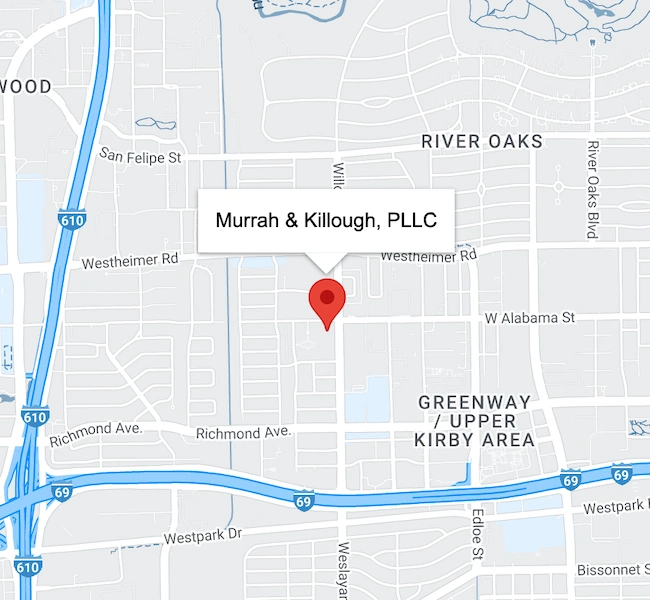
Houston Office
3000 Weslayan St.
Suite 305
Houston, Texas 77027
Phone
281-501-1601
Copyright © 2026 Murrah & Killough, PLLC. All rights reserved.
