

- About Us
- Business Law
- Civil & Commercial
- Family Law
- Resources
- Contact
Our Blog Post
Federal Court Holds Client’s Generative AI Chats regarding Case are Not Protected by Attorney-Client Privilege or Work Product Doctrine

AI is a powerful tool in the hands of clients seeking legal information and advice. The attorney-client communication privilege and the work product doctrine protect confidential legal information and important aspects of the client-lawyer relationship.
A federal court has now answered an important question: When a user communicates with a publicly available AI platform in connection with a pending case, are those communications protected by either doctrine?
In a new decision, United States v. Heppner, a New York federal court held that a criminal defendant’s written exchanges with generative AI were not protected by either the attorney-client privilege or the work product doctrine.
The case arose when the government seized thirty-one communications from Bradley Heppner that he had prepared with the assistance of Claude after receiving a grand jury subpoena.
Heppner argued that the materials should be protected because he had input information learned from counsel, prepared the AI documents in order to speak with counsel and obtain legal advice, and later shared the material with counsel. However, Heppner’s counsel had not directed Heppner to run the Claude searches.
The court rejected the attorney-client privilege claim for three principal reasons. First, Claude is not a lawyer, and communications between two non-lawyers do not become privileged merely because the subject matter is legal. Second, the court found the communications were not confidential, relying heavily on the AI platform’s privacy terms and the lack of any reasonable expectation that user inputs and outputs would remain private from the platform or immune from disclosure to others.
Third, the court held that Heppner was not using Claude to obtain legal advice from counsel. Sharing the results with counsel later does not retroactively convert non-privileged communications into privileged ones.
The court also held that although the work product doctrine protects materials prepared in anticipation of litigation, Heppner’s AI documents were not prepared by or at the direction of counsel and did not disclose defense counsel’s strategy at the time they were created. In the court’s view, the documents were prepared by Heppner on his own initiative, and thus not subject to the protection of the work product doctrine.
In sum, the court made a sharp distinction between counsel-directed litigation preparation and a represented client’s independent use of a public AI tool to analyze facts and possible arguments. The logic of Heppner should apply in both civil and criminal matters.
For now, the prudent course is simple: clients should not input, upload, or summarize litigation-related communications or legal analyses into generative AI platforms without first consulting counsel.
Until a court in the relevant jurisdiction says otherwise, parties should assume that self-directed use of public AI tools may fall outside traditional privilege protections and may create avoidable waivers and discovery risks.
Heppner matters because it is one of the first decisions to apply traditional privilege principles directly to generative AI use by a client.
Its reasoning is straightforward and likely to be influential: no attorney on the other side of the exchange, no confidentiality, no counsel direction, and no basis for treating self-directed AI use as protected legal preparation simply because it relates to a pending matter.
If you have questions about how generative AI may affect litigation strategy, discovery, privilege, waiver, or work-product protection, please contact Richard C. Killough at rkillough@mktxlaw.com or reach out to any member of the Murrah & Killough litigation team.
This bulletin is provided for general informational purposes only and is not legal advice. Its contents may not apply to your specific circumstances, and you should not act or refrain from acting based on this bulletin without seeking legal advice from counsel. Receipt of this bulletin does not create an attorney-client relationship with Murrah & Killough, PLLC.
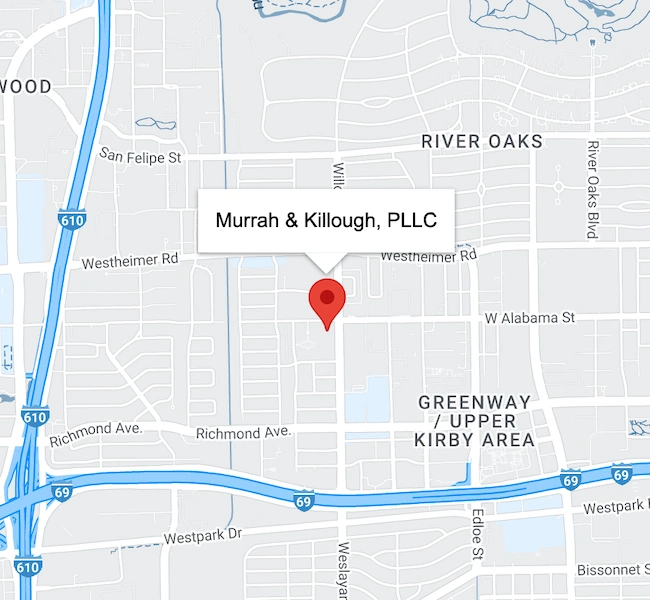
Our Houston Office
3000 Weslayan St. Suite 305
Houston, Texas 77027
Phone: (281) 501-1601
Contact Our Team Today!
Fields Marked With An “*” Are Required
"*" indicates required fields

Houston Office
3000 Weslayan St.
Suite 305
Houston, Texas 77027
Phone
281-501-1601
Copyright © 2026 Murrah & Killough, PLLC. All rights reserved.
