

- About Us
- Business Law
- Civil & Commercial
- Family Law
- Resources
- Contact
Our Blog Post
What Counts as a Breach of Contract in Texas?

In Texas, a breach of contract occurs when one party fails to perform their obligations under a valid, enforceable agreement without a legally recognized excuse. Not every missed deadline or miscommunication rises to that level, and the distinction between a true breach and a business dispute can determine whether you have a claim worth pursuing.
What Makes a Contract Valid?
Before a breach of contract can occur, there has to be a contract worth enforcing. In Texas, a valid contract requires four things:
- An offer
- Acceptance of that offer
- Mutual consideration (meaning both sides give something of value)
- A meeting of the minds on the essential terms (meaning both parties understood and agreed to what the contract required)
Courts look at what the parties said and did, not what they claim they were thinking, to determine whether a real agreement existed.
The Four Elements of a Breach of Contract Claim in Texas
Texas courts evaluate breach of contract claims using four elements, all of which must be present to support a lawsuit:
- A valid, enforceable contract existed between the parties
- The party bringing the claim performed (or had a legitimate reason not to)
- The other party failed to perform its contractual duties
- That failure caused actual, quantifiable damages
All four elements must be present. A contract violation that causes no real harm may not support a lawsuit, even if the other side clearly dropped the ball on their obligations.
Types of Breach in Texas
Not every breach carries the same legal weight. Texas common law recognizes several categories, each with different consequences.
Material Breach
A material breach is the most serious kind. It goes to the heart of the agreement, and the failure is significant enough to deprive the non-breaching party of the benefit they were promised. When a material breach occurs, the non-breaching party is generally excused from continuing to perform their own obligations and can pursue damages.
Texas courts weigh several factors when evaluating materiality, including how much the non-breaching party was deprived of expected benefits, whether the breach can realistically be cured, and whether the breaching party acted in good faith. No single factor is determinative; courts look at the full picture.
For example, if a manufacturer contracts to deliver 10,000 units of a product by a set date and delivers nothing, that is almost certainly a material breach. The buyer’s entire business plan may have depended on that shipment.
Minor (Partial) Breach
A minor breach, sometimes called a partial breach, happens when one party substantially performs but falls short on a secondary term. The contract remains enforceable, and the non-breaching party must still hold up their end, but they may recover damages tied to the specific deficiency.
For example, a vendor who delivers the right product two days late, when the contract did not specify time as a critical term, has likely committed a minor breach. The buyer may be entitled to compensation for any provable losses from the delay, but they cannot walk away from the deal entirely.
Anticipatory Breach
An anticipatory breach happens before any performance is actually due. When one party clearly communicates (through words or conduct) that they will not fulfill their obligations, the other party does not have to wait for the deadline to arrive before taking action.
To bring an anticipatory breach claim, the following must be established:
- An absolute repudiation of the contractual obligation
- No legitimate excuse for that repudiation
- Actual damage to the non-repudiating party
The keyword is “absolute.” If a vendor calls to say they are running behind, that is not repudiation; that is communication. Repudiation means the party has made clear they will not perform at all.
What Remedies Are Available?
When a breach of contract is established, there are several paths to potential recovery, including:
- Compensatory damages: The most common remedy is financial compensation for losses directly caused by the breach, intended to put the non-breaching party in the position they would have been in had the contract been honored.
- Consequential damages: This is compensation for indirect losses that flow from the breach, provided they were foreseeable at the time the contract was formed.
- Liquidated damages: Pre-agreed amounts specified in the contract itself, intended to estimate damages in advance. For example, a construction contract might include a clause specifying $500 per day for every day a project runs past the completion date.
- Specific performance: A court order requiring the breaching party to fulfill their obligations, typically available when money alone does not make the non-breaching party whole. This remedy comes up most often in real estate transactions, where the property itself, not just its dollar value, is what the buyer bargained for.
- Rescission: Cancellation of the contract, releasing both parties from further performance.
The right remedy depends on the nature of the breach, the terms of the contract, and the actual harm suffered.
How Long Do You Have to File a Claim?
In Texas, breach of contract claims generally must be filed within four years from the date the cause of action accrues, under Texas Civil Practice and Remedies Code § 16.004. That clock generally starts when the breach occurs, and not when you discover it. Waiting too long can bar an otherwise valid claim entirely, regardless of how strong the underlying case may be.
Speak With Murrah & Killough, PLLC About a Potential Breach of Contract Dispute in Houston
Business disputes involving contracts can range from a disagreement over payment terms to a full-scale failure of a multi-year service agreement. Across Houston, the same core issue comes up regardless of industry: one party believes the other did not deliver what was promised.
Murrah & Killough, PLLC handles legal disputes for both individuals and businesses, serving as your outside general counsel when contract conflicts arise across a spectrum of industries, including service industries, healthcare practices, and manufacturing. To speak with our team, call (281) 501-1601 or contact us online.
Contact Murrah & Killough, PLLC for skilled business law litigation.
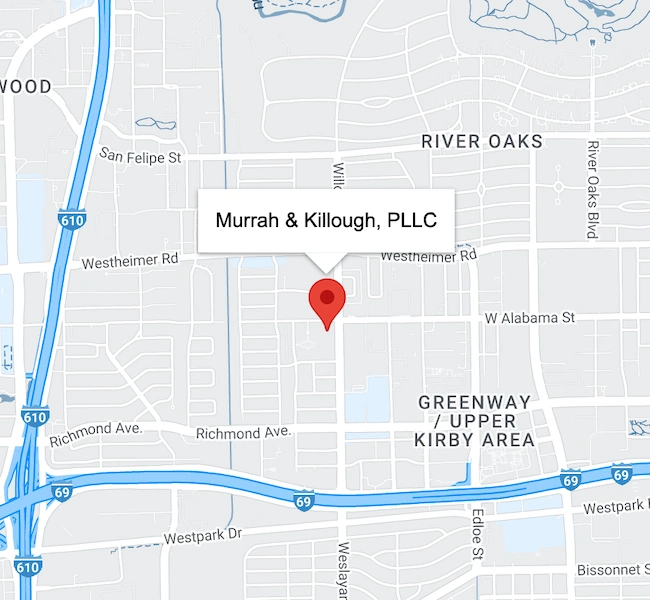
Contact the experienced lawyers at Murrah & Killough, PLLC today & schedule your free consultation. We proudly serve Houston, & all throughout Texas. Visit our law offices at:
Our Houston Office
3000 Weslayan St. Suite 305
Houston, Texas 77027
Phone: (281) 501-1601
Contact Our Team Today!
Fields Marked With An “*” Are Required
"*" indicates required fields

Houston Office
3000 Weslayan St.
Suite 305
Houston, Texas 77027
Phone
281-501-1601
Copyright © 2026 Murrah & Killough, PLLC. All rights reserved.
